

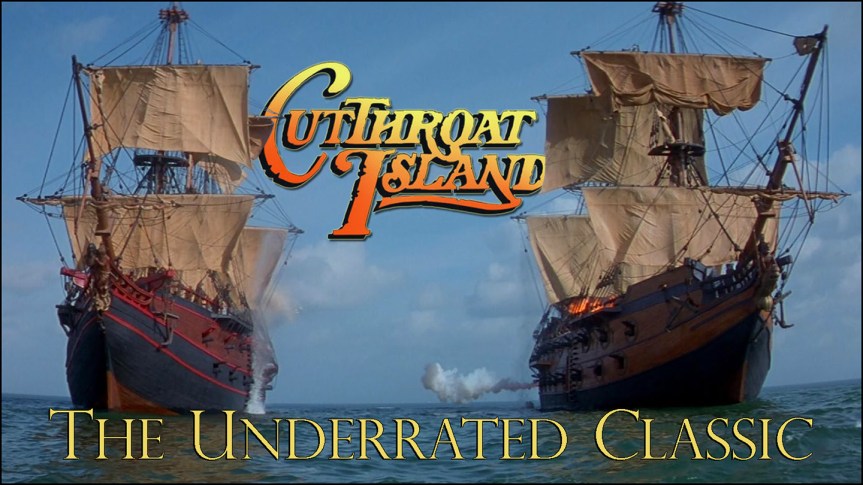
Pensacola, Fla. (Feb. 15, 2024) – Cutthroat Island was a disaster.
The movie cost around $100 million—and that was back in 1995! The film grossed about $10 million, and its losses were so high that Carolco Pictures’ financial hull was holed, sinking the studio to the depths of Davey Jones’ Locker. Of course, Carolco was already in a whale of a financial pickle, and they bet everything and the kitchen sink that one movie would save them.
Whole books with enough pages to choke a mule could be written on the disaster that was Cutthroat Island. Financial mismanagement, cast and crew injuries, disastrous complications with the sets, and a hilariously bungled marketing campaign (courtesy of Carolco’s financial woes) torpedoed whatever shot the film had at success.
What I find lacking in these discussions is the film itself. Was the story any good, or was it a crap show? Was it a well-written yarn sabotaged by external factors, or was it such a badly written piece of sludge it deserved its fate?
Cutthroat Island is one of my top ten favorite films. I was captivated by it back in 1995, and it’s still one of my go-to flicks for adventure. It’s not a badly written (or acted) film at all. Some weaknesses prevent it from receiving the same five stars as Pirates of the Caribbean: Curse of the Black Pearl does. But Cutthroat Island definitely gets four solid stars.
Let’s break this down by a few storytelling fundamentals: Motivations, Character Arcs, and Narrative Structures / Story Execution.
Motivations
All the characters’ motivations are pretty clear, but we’ll focus on three: Morgan Adams, William Shaw, and Douglas “Dawg” Brown.
Morgan Adams (Gina Davis) wants to avenge her father’s death and secure the treasure her grandfather looted for herself and her crew.
Douglas ‘Dawg” Brown killed all three of his brothers to get the map needed to obtain the treasure for himself.
William Shaw (Matthew Modine) wants the treasure for himself because he’s a greedy thief (think Dawg Brown, but without the psychotic violence).
These are very clear, strong, and well-defined motivations. These motivations easily and powerfully propel these three characters into action and a wonderfully multi-layered conflict. Their personal desires collide spectacularly, generating a natural drama between them.
Now, all three are thieves (two pirates and one sneak thief), but thievery in this instance is the motivation for only two of them: Dawg Brown and William Shaw. Interestingly enough, Shaw starts out nearly as much a threat to Morgan Adams as Dawg is—the only difference being that Shaw lacks Dawg’s propensity to violent narcissism, utilizing instead an oily, sneaky narcissism.
One could argue Shaw’s threat is actually the more dangerous one, seeing as he’s aboard Morgan’s ship and trying to stab her in the metaphorical back.
Morgan Adams is the only one with anything resembling a ‘higher’ motivation here. She wants to avenge the murder of her father at Dawg’s hands and get the treasure for her and her crew. Morgan views her crew as her crew, her partners, so, for her, it’s a moral imperative to divide the treasure among her sailors. She works to motivate them to work together under her lead for the prize.
Shaw simply wants it for himself and relies on himself to achieve this end.
Dawg simply wants it for himself, and looks at his crew as merely disposable tools. This psychopathy is demonstrated when he casually murders one of his men. That sailor’s crime? Pointing out to Dawg that Dawg’s ship, the Reaper, doesn’t yet have enough food aboard for everyone. Dawg kills him to reduce the ‘mouths’ aboard and reinforce his demand for unquestioned obedience.
Character Arcs
Morgan Adams is no Mary Sue. It’s implied that her dilly-dallying before the opening of the film created the opening for Dawg to capture her father. Her drunken behavior aboard her father’s ship after his death creates doubt in the minds of the men she’s trying to take authority over her—and this comes back to haunt her. She opens the narrative as a capable, yet immature, short-sighted sailor who tends to gloss over very real dangers and obstacles.
She convinces the men of (now) her ship, the Morning Star, to follow her, but she doesn’t do it by relying on herself. She uses the memory of her father (their deceased captain) to emotionally appeal to them while holding out hope for the treasure. She bargains with the men for time to prove herself. This isn’t necessarily a bad strategy (it works, after all), but she doesn’t decisively follow it up. It’s clear she’s trying, but is more ‘playing’ captain than being captain.
She gives up her only ace (the location of the treasure) when some of her men mutiny, instead of cleverly using it as a bargaining chip. Granted, her hand in that confrontation was very weak, but her quick reveal of the treasure destroyed any chance she might have had to regain control. Failing to ‘read the room,’ as it were, she naively hands over the only thing she might have used to corral the mutineers.
In short, she’s a novice assuming command primarily for revenge and gain, but the hard knocks she experiences force a choice upon her: grow into being a captain, or else quit.
Her genuine concern for her men is proved when she reacts angrily to seeing the mutineers betraying the rest to Dawg and his allies. She doesn’t just plot how to get the treasure, she and her remaining band plot how to get the treasure and rescue their comrades by retaking the Morning Star.
There is a real feeling of hope when she sneaks back aboard her ship and liberates her loyal sailors. By the time the ships are heading towards their final clash, she acts like a captain. She is confident, she trusts in herself because she found the treasure, kept her crew alive, and even coopted Shaw’s character into an ally…and potential love interest. She learned from her failures and grew.
She takes command of her ship by nearly begging for the chance to lead, and has to repeatedly persuade her men to follow her. She’s trying to act like a captain, but isn’t. By the final battle, she is The Captain, commanding her ship and crew into a successful action against Dawg’s bigger and more powerful ship.
There are instances where this arc could have been fleshed out, her inexperience delved into. One would have been a quiet conversation with one of her loyal men after their exile from the ship, a moment where she could confront her failings, regroup herself, and move forward. Alas, this opportunity was missed, and the story of her arc does drop a notch or two in the “oomph!” department because of it.
William Shaw is a sneak thief thrust into this game of pirate family feud. His sole motivation is to survive and get rich. He finds the hidden island first, but he does it by trying to betray Morgan’s trust. She catches him and locks him in the brig.
Shaw escapes during the mutiny, but now he faces a choice: throw his lot in with Morgan as she and some of her men are banished during a storm in a long boat…or stick with mutineers. He sides with Morgan, but is separated from her group by the same storm.
Interestingly enough, Shaw’s character retains a streak of moral ambiguity right up until nearly the final credits. He finally sides with Morgan and is captured for it. He does attack one of Morgan’s ‘friends’ who betrayed them all, clearly showing he’s become loyal to her. However, his avoidance of the final battle to try and get the treasure unsecured from Dawg’s hold leads one to wonder if his old ways are too tempting? Was he trying to get some for himself, or did he recognize his inability to fight on a level that could match these experienced buccaneers, and so tried to do what he could for his new team?
The question lingers, leaving a lingering tinge of ambiguous color to his character. This somewhat unresolved arc lends depth to him because it paints him as very human. Even the most altruistic of us have ulterior motives. The mere shadow of a doubt establishes an undercurrent of unpredictability and danger in him—and that is the kind of character people love!
Dawg’s arc is the simplest: he’s a greedy jerk who wants it all for himself. He holds himself as the superior of his brothers…and this is borne out to a degree by the fact he kills all of them. Morgan’s stubborn refusal to surrender (or die) impresses him enough that he declares her “harder to kill” than her father, that she “exceeds” all his brothers, in fact…but familial affection is no deterrent to him trying to kill her. She is simply an obstacle to be removed in the attainment of what he wants.
These are solid character arcs. Morgan grows into being a true captain, and is rewarded with genuine loyalty and ultimate success.
William Saw remains a bit of a morally ambiguous character, but extraordinary events force him to make choices that define him in stronger colors. He develops genuine loyalty, and even romantic affection, for Morgan. He becomes dependent on her guidance and leadership. Even by the film’s end, when one can still question just how self-centered he remains, it’s very clear his ‘default’ setting now is loyalty to his new captain.
Dawg exhibits the classic downfall of many a great villain: a myopically vain and self-centered obsession that leads him to his death. Right to the literal last moment of his life, he thinks Morgan can’t beat him, no matter what. He is so focused on his physical strength and prowess as a swordsman that it simply doesn’t occur to him Morgan might outthink him.
Well, that is until she tricks him into standing in front of a cannon she fires off, blasting him right through the side of his ship.
Narrative Structure / Story Execution
Cutthroat Island is a decently paced movie. The closest it comes to lingering is on the island as Morgan and her men search for the treasure, but the audience isn’t allowed to zone out. Dawg’s close pursuit turns the quiet jungle into a treacherous minefield. Each caw of a bird might be Dawg’s men signaling to each other. Each snap of a twig might be Dawg’s men closing in. The jungle is no more a safe refuge for Mogan and her band than her ship was.
That’s not to say there aren’t some hangups. When Morgan and her men are able to save Shaw, they’re all a bit too quick to let him ‘into’ the group instead of keeping him at arm’s length. This might have been addressed by some of the men objecting to her trust in Shaw—and that would have given her another opportunity to bring them to her side further by demonstrating her growing confidence.
During a few of the stunts, the harnesses securing the actors to the ropes they’re swinging on are visible, and, once noticed, you can’t un-notice the glitch. This minor lack of attention to detail cracks the illusion a bit, pulling the audience away from the narrative’s ‘reality’ a bit. During the final battle, a few frames of film (a cannon being blasted apart below decks) are reused. Again, once this is seen, it breaks the reality and rhythm of the epic showdown.
One of the traitors aboard Morgan’s ship gives away her location by using a carrier pigeon. This is perfectly correct ‘technology’ for the 17th century, except…
He sends the pigeon out in the middle of a raging storm. There is no way that bird would have survived the tempest as shown on screen. Again, a small thing ‘landlubbers’ might not think about when crafting a sea-faring yarn, but anyone with two minutes of experience watching (and feeling) the winds during a roiling, boiling storm at sea will be yanked right out of the story by this bird-brained idea.
The single most egregious example of bad writing is Morgan’s weak sauce failure to save Shaw at the end right before the battle starts. This one narrative failing alone is more than enough to result in the film getting my four stars (instead of five) because it’s an unnecessary momentary regression of Morgan back to being a doubtful, uncertain pretender instead of The Captain.
Dawg’s about to hang Willam from the yardarm aboard the Reaper, so Morgan grabs a gun to shoot from her ship and save William. However, she hesitates…and hesitates…and hesitates so long one of her men takes the shot of his own accord. In reality, this kind of behavior would never be tolerated because that sailor just usurped command from the captain. On a real deck, she’d have to immediately roast that man to reestablish her authority, or else the crew would likely quickly begin to question their loyalty to such a weak sauce commander.
However, taken together, these weaknesses don’t overshadow the fact that Cutthroat Island is a remarkably well-crafted story. It’s no Oscar-winning classic, nor was it intended to be. It functions as designed: a swashbuckling, rollicking adventure about pirates, lost treasure, and epic battles. Its characters exhibit solid motivations and arcs, its pacing is captivating, its action sequences unique and interesting (where else can you see a horse-drawn carriage being fired up by a ship-of-the-line’s full broadside?).
Cutthroat Island never stood a chance, but not because it’s a bad movie. The film grounded hard upon the rocks of a studio out of money gambling everything it had left on one film…but the ‘everything it had left’ didn’t include enough money to properly market the film. This lackluster effort, combined with the deliciously scandalous stories about the problems on set, generated a perception the film was simply irredeemable.
Despite these obstacles, Cutthroat Island holds up remarkably well when viewed for its own merits. Get the studio debacle out of the way, and the story proves to be a strong, satisfying narrative portrayed by a talented cast while also being a solid example of generally good writing and characterization.
** ** **
#nathanaelmiller, #sparks1524, #cutthroatisland, #pirates, #movie, #piratemovie, #accidentaldetecive,
 Sparks1524