

PENSACOLA, Fla. (April 25, 2024) – M. Night Shyamalan created one of the greatest literary twists of all time in 1999’s The Sixth Sense.
Shyamalan needed a mere 108 minutes to stun audiences so completely that The Sixth Sense is rightly credited as a master class in a perfectly executed twist, but a 24-minute cartoon also achieved the same goal in 2005.
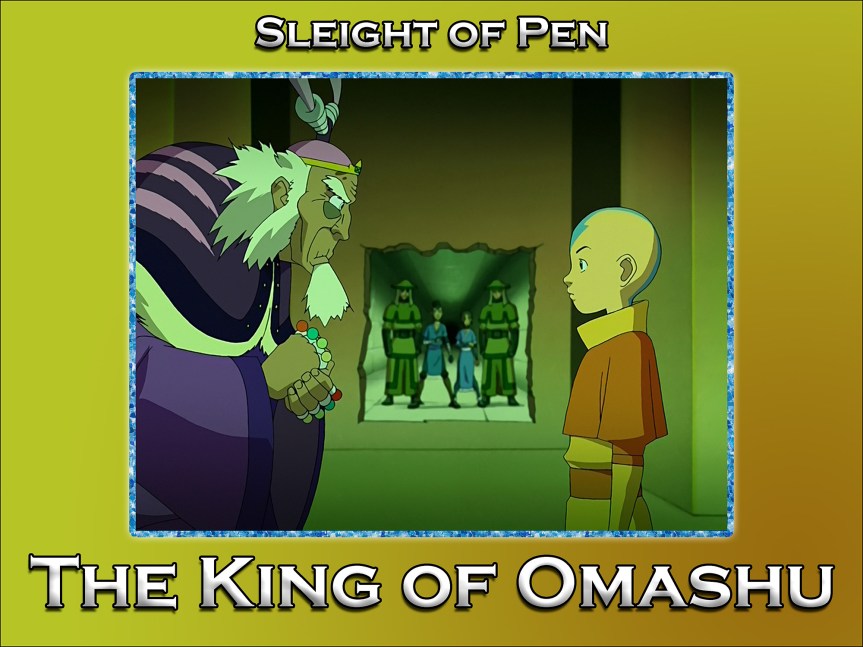
Avatar: The Last Airbender came out in 2005, and Season 1, Episode 5: The King of Omashu, provides as stunning a twist as The Sixth Sense delivered.
By the way, spoiler alerts are now in effect. YOU ARE WARNED!
Aang is the reincarnation of the Avatar, a powerful being who can provide balance and order to the world. The world is now at war, but Aang, the new Avatar was missing for a hundred years. He was frozen in ice as a boy for a century before being revived, meaning young Aang has his work cut out for him. He has to grow up fast, and it’s not always pretty!
Aang and two friends embark on a journey to find the training he needs, which brings them to the Kingdom of Omashu and its totally bonkers ruler.
The King of Omashu is an old—and I mean old—man with a reputation for being crazy as a loon…and his behavior certainly proves it.
Aang visited Omashu a hundred years earlier (prior to his being frozen). During his visit, he became friends with Bumi, a wild kid who pulls unexpected stunts and plays whacky games. Being focused on playing with Bumi, Aang had no knowledge or experience with Omashu’s rulers, so he could offer no guidance to the current king’s insane behavior.
The moonbat monarch threatens to kill Aang’s companions unless Aang wins three challenges. Each challenge opens with a ghastly premise for a ridiculous objective, such as saving the king’s pet from a hideous monster. However, Aang repeatedly discovers he can win by thinking completely outside the box. For example, the rabbit he’s trying to save is not the king’s pet; the monster is! Once he calls the monster by name, the creature begins to act like nothing more than a happy dog!
The batty old king congratulates Aang on overcoming the three tests, then hits him with one more. Aang must guess the king’s name. Aang is completely at a loss, what with having heard no one in the kingdom utter the king’s name. The king gives him one hint: the clues to the his name are in the challenges Aang overcame.
The young Avatar thinks hard, reflecting on the common factor each challenge possessed. Aang is struck by inspiration, which leads to recognition.
The crazy old king is Bumi grown up and grown old! King Bumi smiles, revealing he never intended to harm Aang’s friends; he simply needed to ensure Aang understood that he must to find creative, unique solutions to the challenges he will face ending the war.
I can hear you asking, “Ok, but, what in the name of John Q. Arbuckle does any of that has to do with how The King of Omashu is itself a masterclass in blindsiding your audience with a twist?”
The Sixth Sense exemplifies the factors needed to hoodwink your audience. The Sixth Sense actually shows the audience everything, from Bruce Willis’ character being shot to the fact that his character only interacts with the boy. We see him talking to his wife, but we never see her respond. We see him talking to the boy in the presence of other people, but no one reacts to him except the boy.
And, of course, the movie’s most famous line is, “I see dead people.” We, the audience, all assumed Bruce Willis’ character survived his shooting, but this is where Shyamalan used our assumptions against us. The clues were in front of us the whole time; none of us looked at them for what they were because we assumed something different.
I currently write detective stories. Part of writing a good mystery is giving your audience enough clues for them to at least get a handle on the ‘who done it,’ but arranging those clues in a way that obscures the reality of those clues.
A good detective will change his or her theory to fit the facts, but that line of thinking contradicts instinctive human nature. We automatically try to change facts to fit a theory in what’s known as ‘confirmation bias.’ The Sixth Sense and The King of Omashu both use that against us.
The King of Omashu freaking shows us who the king is during Aang’s flashback as he talks about Bumi! Bumi is batty; the king is batty. Bumi squints with one eye; the king squints with one eye (same facial expression). Bumi is unpredictable and comes up with crazy games; the king is unpredictable and comes up with crazy challenges.
The King of Omashu follows the same pattern The Sixth Sense did, but needs only 24 minutes to do it. The writers provide all the necessary clues, but in a way that we, the audience, assume are in a different context to the story’s central question…but those clues fall into a logical order once we see the actual context instead of the misdirection.
Misdirection works when you give your audience truth, but you arrange that truth into a context which alters its apparent meaning, but not its actual meaning. The Sixth Sense and The King of Omashu use this to chillingly fun effect, ensuring the audience is shocked and thrilled as the magician reveals his literary sleight-of-hand.
Study successful examples of shocking twists, and you’ll begin to learn how the magic works. Once you get the hand of waving your literary wand, you too will startle and delight your audience with the sublime magic of a successful shocking twist!
## ## ##
#nathanaelmiller, #sparsk1524, #novelist, #accidentaldetective, #isaacshepherd, #abrahamgray, #mystery, #detective, #writing, #writer, #twistending,
 Sparks1524