

The end of the Golden Age of Ocean Liners
-Nathanael Miller
(Pensacola, Florida; 10 November 2026) – Departing New York on 03 July 1952, the SS United States sliced across the Atlantic Ocean to Great Britain in a mere three days, ten hours, and 40 minutes.
That record remains standing today; no ocean liner ever exceeded this incredible feat.
Sadly, the United States entered service right at the dawn of the jet age. Very much the pinnacle of ocean liner engineering, the 990-foot ship was almost immediately displaced by those new-fangled passenger jet aircraft. After all, who wants to spend over three days at sea when a jet can get them across in about eight hours?
The great Golden Age of Ocean Liners arguably kicked off right around 1900. By the dawn of the 20th century, shipping lines had realized that, to increase passenger revenue, they had to increase passenger loads. This meant solving the safety issues that had made sea voyages a deadly gamble since the time before time while also building giant metal vehicles offering the comforts of a hotel on land.
Liners such as Cunard’s Aquitania and Mauretania, and White Star’s Olympic, are still reverently spoken of as, perhaps, the greatest of the classical-era liners. Their fame carried the day until the 1930s, when newer ships came into service. Liners such as the (now merged) Cunard-White Star Line’s Queen Mary and the French Compagnie Générale Transatlantique line’s Normandie began introducing sleeker, more modern amenities and greater speeds.
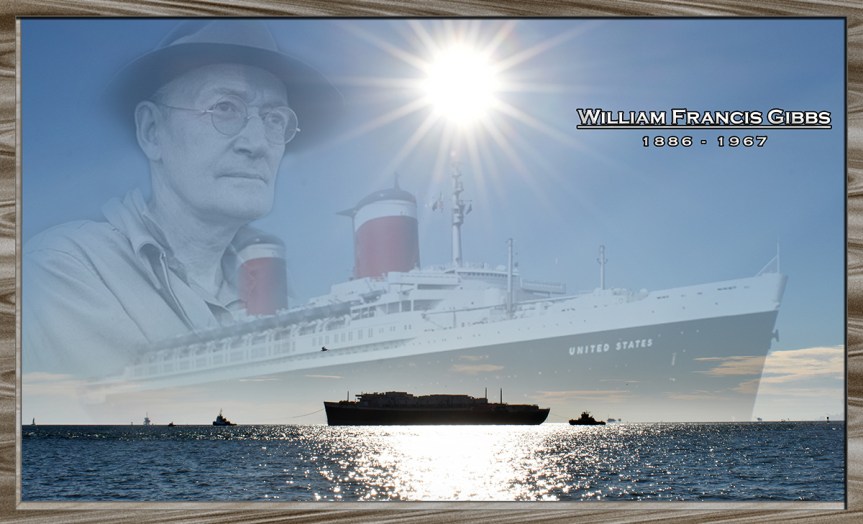
The United States Lines was formed to compete in 1921 just as the classical era of ocean liners was beginning to fade into the heady pre-war decades. American marine engineer (and sheer engineering genius) William Francis Gibbs became the face of American sea-going commercial transportation. Gibbs’ SS America was but a warm-up for his great Tour de Force, the first American superliner and the ship he intended be the greatest superliner in the world.
Sadly, a pesky little conflict known as World War II torpedoed international travel.
The conclusion of the war allowed Gibbs to finally build the mighty and elegant SS United States. Laid down in 1950 and completed in 1952, the “Big U” departed on her maiden voyage on 03 July 1952, setting that stunning record during the crossing.
However, Gibbs’ high-flying dreams were soon grounded by the high-flying airplane. The United States was withdrawn from service in 1969. By the 2020s, the derelict vessel had been through numerous plans for revitalization, but none came to fruition. The die was cast: the ship was going to be torn apart into tiny slivers of scrap metal unless something radical occurred.
Enter Okaloosa County in northwest Florida.
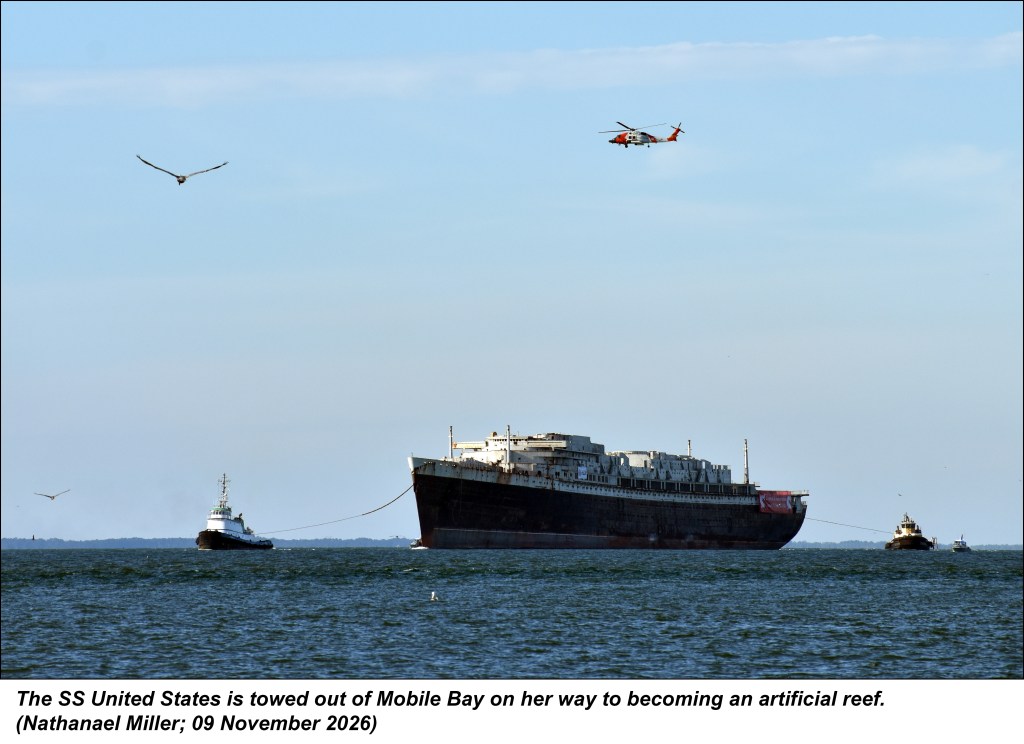
Purchasing the ship in 2024, the county had the Big U towed from Philadelphia to Mobile, Alabama, in March of 2025. The ship then spent over a year being stripped of historical fittings and all hazardous materials to prepare her for preservation by…sinking her.
Tomorrow, 11 November 2026, the United States becomes the world’s largest artificial reef off Okaloosa County. Once the pinnacle of marine engineering and speed, once a ship that carried movie stars and Presidents, the United States will end her life by providing a stable habitat for sea life.
The passing of any ship into the night of history is a bittersweet moment, especially for those of us who are sailors. The stark reality of historic preservation is that very little can actually be preserved for posterity, especially when that “very little” involves very big items like ships, which require rather massive amounts of money and labor to keep shipshape in Bristol fashion. Economic reality is a brutal master that will not be denied.
The United States can’t be saved as a museum, but, is there really a better legacy for a ship than to become a living monument fostering life in the oceans she was built to love? Such a new life sure as hell beats having her unceremoniously torn apart for scrap!
The United States’ passage out of Mobile Bay yesterday was a unique, and very literal, moment in history; the final period on the final sentence in the final chapter of the Golden Age of Ocean Liners. Never again will elegant leviathans charge across the oceans ferrying thousands of passengers between continents while embodying the stuff dreams are made of.
However, our modern world of rapid global transportation was first realized by the great Golden Age of Ocean Liners. Yesterday, this era of history came to a quiet, sedate end marked by stately grace as the United States departed her final harbor quietly, sedately, and with stately grace.
These great ships have now sailed into the sunset of history. We will never see their like again, but the legend of these oceanic giants will fire the human imagination for countless centuries to come.
## ## ##
#nathanaelmiller; #sparks1524; #SSUnitedStates, #oceanliner,

