

The SS United States Chooses a Most Poetic Exit
-Nathanael Miller
(Pensacola, Florida; 11 November 2026) – It is currently 20:40 hours as I publish this. I was not expecting to write anything tonight, much less address the passing of the SS United States following my thoughts of yesterday.
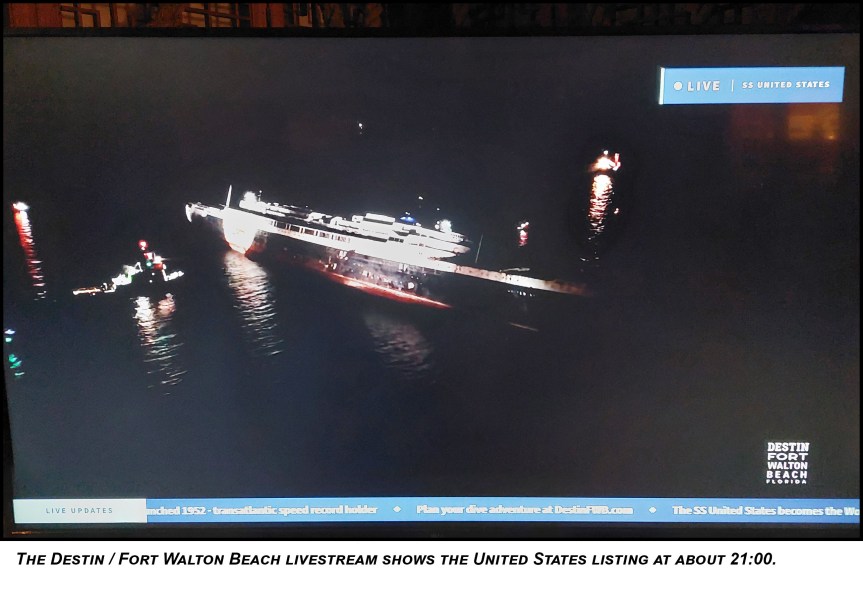
However, the old girl is still above the surface. Her sinking was moved up to this afternoon due to inclement weather predicted for tomorrow (12 November). This required the final prep and flooding to be done today, instead of final prep today and sinking tomorrow. She was expected to be on the bottom by about 14:00, then around 14:30–14:45…and then the officials declared they were declaring a “final descent” time no more.
The United States is flooding as I write this. I’m watching her on a livestream right now.
However, the old girl remains above the waves. She is sinking; don’t mistake that. Even so, despite the best efforts of mice and men, William Francis Gibbs’ engineering triumph is proving just how triumphant that man’s legacy, and his elegant creation, are.
Old sailors like me often believe that ships do have spirits; souls of their own. We can hear them speak to us in our hearts in a way the landlocked cannot.
I swear I can hear the United States laughing at us. I swear the old girl is pranking us! Think about it: the fastest ocean liner ever built is taking forever to sink! It’s as if she’s looking at us all and saying, “Well, you should have been faster!”
William Gibbs built the two greatest American liners – the SS America and, following World War II, the SS United States.
Both of his maritime marvels have now ended their active lives on their terms, not ours. The America went out in a spectacular blaze of shipwreck glory. The United States chose a different route; she’s going out with such understated grace that it doesn’t actually look like she’s going anywhere at all.
The America was launched the day before World War II kicked off in Europe in 1939. She ended up having a truly storied career as a phenomenally successful troop ship during the war. She carried over 350,000 troops from 1942 – 1945. In fact, during one mission in 1944, she carried 9,305 people all at once. Like the British Queen Mary, the America was credited as being one of the Allies’ great strategic assets during the war.
America then served America as a transatlantic liner until being withdrawn from service in 1964 and sold to a Greek line. She spent the decades slowly deteriorating while being used and neglected until she finally had had enough.
Renamed the American Star in 1993, the ship was under tow when she snapped the line during a storm, eventually grounding on 18 January 1994 at Fuerteventura in the Canary Islands. Although initially thought to be salvageable, the ship was snapped clean in half after only 48 hours by unfathomably heavy seas, resulting in her wreck sitting on the shoreline for years. The spectacular nature of her destruction led to America gaining an odd resurgence of interest. Whereas she might have simply been forgotten by a society obsessed with a high-speed life, her wreck ensured she was noticed anew, and will not be forgotten.
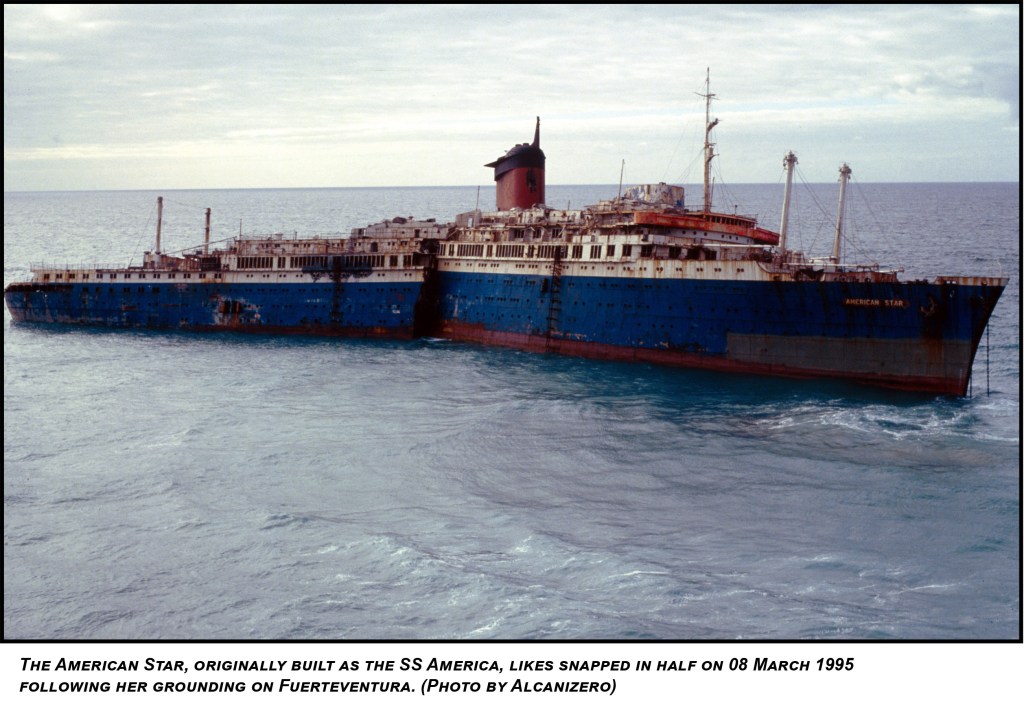
Like I said, if ships have spirits, then America’s spirit decided to go out in style with a spectacular conclusion no one can forget.
Tonight, her younger and larger sister, the United States, is slowly (emphasis on slooowly…) settling into the Gulf of America. Expected to sink in 45 minutes once major flooding commenced, the United States is now settling with all the speed of a geriatric snail that forgot to charge its mobility scooter.
William Gibbs’ America chose to go out in style; his United States has chosen to go out subtly, quietly, sedately. Poetically, even.
She is a ship quite literally passing us in the night.
I’m a novelist. We writers use devices like the stereotypical “riding off into the sunset” because those narrative devices work. They provide readers closure in a satisfying manner. The books and movies and TV shows that we remember are remembered because they used such devices to impact us emotionally, intellectually, and even spiritually.
I could not have written a more understated, poetic end for a ship than what the United States is writing for herself right at this moment. Her stubborn determination to do this thing her way is a testimony to the absolute genius of her builder. Clearly, William Francis Gibbs was the GOAT of the shipwright’s art. Despite all our planning, calculations, and computer modeling, we can’t sink his 20th Century ship with any speed no matter how hard we’ve tried with 21st Century technology and experience.
The Golden Age of Ocean Liners ended on Monday, 09 November 2026, as United States departed her final port. These great ships have sailed into the sunset of history, and the final moment of that legendary age has been taken out of human hands by the very ship that age ended with.
Tomorrow there will be recriminations, accusations of incompetence, frantic after-action meetings to figure out “what went wrong.” Tomorrow there will be the usual frenetic hullabaloo we humans always skitter into when our grand plans are thrown awry and we’re reminded of just how little control we really have over our world.
But, that’s tomorrow.
Tonight…this quiet, dark, peaceful night…tonight we sailors who can hear the spirits of ships raise a toast to the, in my opinion, single most beautiful modern ship ever built. We will raise a glass because we can hear her laughing at us even as this old ship from a forgotten age reminds us what it means to end a story gracefully and poetically.
The America went out with spectacular drama.
The United States is quietly leaving us behind by being a ship passing beyond us in the night.
## ## ##
#nathanaelmiller; #sparks1524; #SSUnitedStates, #oceanliner,

